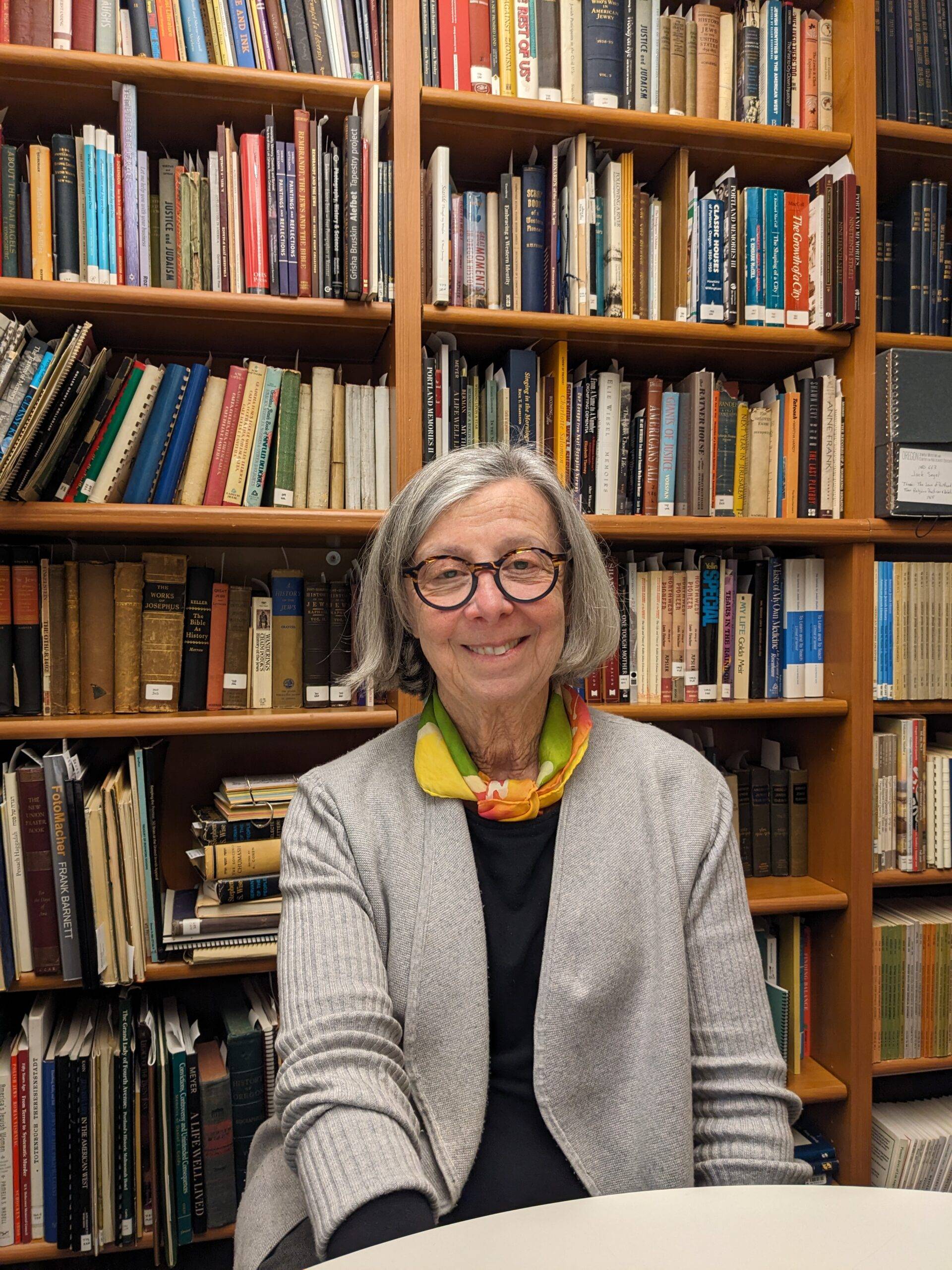
Interview with:
Maria Agoston
Interviewer: Jodi Garber-Simon
Date: March 12, 2025
Garber-Simon: Let’s start. First, let’s tell them your name and where you were born and when.
AGOSTON: My name is Maria Agoston, and my maiden name, Szekely [spells out]. I was born February 8th, 1946, in Bucharest, Romania. That’s not the place I grew up. There is a longer story about how I ended up growing up in Transylvania in the northwestern corner, small town, and returned for college and for my adult life to Bucharest.
Garber-Simon: Let’s talk about that a little bit. Maybe that story about moving to Transylvania starts with the household you were born into. Who did you live with? What were the conditions? The moment you were born, what were things like?
AGOSTON: Being born in 1946, clearly my parents survived the Holocaust. They have a long story, and we will focus on this separately, of how they ended up in a different part of the country — or a different country — during the war. But they survived. They returned to Bucharest, and I was born there, but it was about only one year that we stayed in Bucharest.
Still a mystery to both my sister and I, they decided to head northwest to Transylvania, to the place where my grandparents of my father’s side lived. They were a stern family. My grandfather, because antisemitism was pretty strong at that time, decided to change the name to a more Hungarian-sounding namesake, being a practicing lawyer in a small town. Maybe I should jump to the grandparents’ story because then it would be more obvious why.
Here is a map I have. My father was born in a small town called Seini in Romania. It went back and forth between being a Romanian place, Transylvania, to a Hungarian place. Unfortunately, during the war it was Hungary, Austro-Hungarian, Nazi-occupied and controlled territory. But what you see here, not too far, it’s Sighet, Sighetu Marmatiei. That’s where Elie Wiesel was born and raised, in a very Jewish community, until the age of 15 when the deportation happened. And most of what I know about what happened to my grandparents I never met was from Elie Wiesel’s book Night, the way he describes how the Nazi army came, lined up the Jewish community. Everybody had a single suitcase, were taken to the train and taken to Auschwitz.
Garber-Simon: And these are your dad’s parents?
AGOSTON: My dad’s parents. His brother died young, and cousins that I never met, never heard too much detail. A person who knew the story later told us exactly the same story. They were lined up, single suitcase. They had it until the train. They were taken to the train from there all the way to Auschwitz, never to be heard again.
Garber-Simon: And your dad at that time was not home because he was old enough?
AGOSTON: Well, this is the interesting part. My father studied engineering in Grenoble in France. How did they know? I don’t know. Upon return, after college, he went to Bucharest and worked for IBM of all places. He was an engineer in IBM. My mom, she was born in Transylvania as well, met my father in Bucharest. Here the map shows it, a little bit further. So in the same territory my mom was born and all her family side. The father died when she was only four, shortly after the First World War. But the mother, the sister, her husband, they were all taken to Auschwitz and never, ever returned either.
Garber-Simon: So it’s a miracle that you have two parents. Their whole families were wiped out, and your parents somehow survived. Let’s talk about that. How did they make it?
AGOSTON: That’s the next part of the story. So my father ended up in Bucharest working for IBM. My mom, at that point she aimed to go to college. She wanted to be a piano teacher, but she ended up working as an accountant for Fox movie company, who had something in Bucharest. My parents met on a hike, and they got married October 25th, 1939. They had a small apartment. They still had support from my grandparents most likely. My mom’s sister lived also in Bucharest.
World War Two came. What happened in Romania, in Bucharest? Fascists came to power, but Romania never deported their Jews. Best of our knowledge. Very different to what happened in Transylvania, which after 1940 became Austro-Hungarian, part of the Nazi power, and they deported their Jews. So the mystery — and it’s a true mystery for both my sister and I — is why did my parents leave Bucharest and head to Budapest? My sister thinks that they went first to Seini, the small town, but they ended up in Budapest.
Garber-Simon: This is after you were born?
AGOSTON: No, that was during the war. I was born in ’46, after the war. This was I don’t know what year of the war. Was it a very early stage? Was it 1940, ’41? We don’t know. Somehow it never occurred to us to ask the details. But they took the train, or some other way, to Budapest. My father had an aunt married to a non-Jewish, famous Dutch painter, and they hid my mom. Next mystery is why my father was coerced to sign up for a forced labor camp team? We don’t know. But what happened next is my father was taken on the Russian front, way into Russia. He was part of a forced labor team of 240, and they were taken to dig ditches, to do work for the Nazi army, and they headed east.
My mom, in the meantime, was in hiding with the help of the aunt, and she had false papers. Somehow they found some false papers. During the day, she would sit in a Catholic church and pretend that she was praying, reading there. At night, some friends had a grocery store, and she would spend the night under coffee bags or food bags in the storage space. And this was for years.
As the Nazi troops had to turn back west, since the Russians pushed them back, pushed them out from Russia, the Nazis, they abandoned the forced labor camp team. My father and the rest were totally abandoned. And my father always tells us something very positive about the Russian villagers. He could have never returned would they have not fed them, given them some clothes, helped them. They returned on foot, village to village to village, all the way back. From 240 in my father’s team, six survived. Six. I met one of them. Father was young and strong, a skier and hiker. He survived.
Garber-Simon: Wow. And you met one other?
AGOSTON: I met in Budapest another. They regrouped after the war, when Russia occupied already all the Western Front and Budapest. They met, still terribly scared of the war outcome, at the aunt’s house. They tell scary stories of how if somebody knocked at the door, you didn’t know what will the Russian armies do with these leftover people? So father would step out on the windowsill. They showed us once when I visited. But they survived.
And then the next mystery, they decided to take a freight train back to Bucharest of all places. So again, I don’t know if they knew what happened to their families. We don’t know. Did they know they all perished? Again, we didn’t ask those questions. Somehow we didn’t. And of all places. Well, they had a nice little apartment in Bucharest — and my mom had a sister, we had my little cousin — and so with the freight train they returned to Bucharest.
Garber-Simon: So your mom’s sister was living in Bucharest before the war, and she survived?
AGOSTON: The Romanians didn’t deport their Jews. Her husband was Jewish, and my little cousin, of course. When my parents returned to Bucharest, that was probably’45-ish, they knocked at the door, and my mother’s sister opened the door and they asked them, “Who are you looking for?” They were so unrecognizable because they had not eaten. They suffered. My mom always told the story that her sister, the only one — she had a brother in France, but we never met — did not recognize them.
I’m not sure where father worked then. What did mother do? But then I was born. Yes, 1946. Life came back, and I was born in ’46. My little cousin, who was nine years older, did remember that it was a snowy day [when I was born], that the school was closed, and that made him very happy. He loved to pull me on a sled as a baby.
Garber-Simon: So when you were born, were you living with your mom’s sister and your cousin? Nearby?
AGOSTON: No, we were just in Bucharest. I don’t even know, to tell the truth, how close. I know the place because I lived in that place later, when I became an adult.
Garber-Simon: Was it the same place they lived in before the war? They owned it and then abandoned it?
AGOSTON: Yes. Well, they had to abandon it. And then there is a lot of story around what happened after the war with that place. I don’t really know if anybody used it at that time. Again, one of the mysteries. It was a little apartment, very small, had a kitchen. An extremely small little place. That must have been the reason they returned to Bucharest. Maybe, or maybe work. I don’t know if they knew what happened to the family. I don’t know.
Garber-Simon: But they found the sister. That’s probably why they went back, right?
AGOSTON: The sister might have been the reason. But then the next mystery comes. They go back to Transylvania, we have no idea why. I talked to my sister, and I think they assumed that there was some wealth left from a wealthy lawyer’s family. There was a house, there was a vineyard. There was maybe a community that my father grew up in. And they took the train, and they went back to this small, small town called Seini. Again, 60km — I checked — from the place Elie Wiesel grew up.
Garber-Simon: Was anything left when they went back?
AGOSTON: For a short time, they had the house and the vineyard, and then communism came. Now you are a bourgeois, and the house is taken for the community, and the vineyard is taken by the community, and that’s called communism. My sister was born right there in Seini. But then another mystery follows. They moved to a larger, true town, in the sense that it had the bigger schools, it had bigger opportunities.
They moved to Satu Mare, called Satmar in the Jewish community. I’ll return to that story. He was well known, the rabbi from Satmar. He’s known in New York. So how did they decide? There was 30km between the two. My father was a now director or a principal of a metallurgic professional worker education school. It was right across from a synagogue. I never went inside at that time. Communism now was there. We lived in this huge building which housed students. Some were day students, some probably lived there. A huge yard. I remember my sister was still in a crate, and I was just roaming around, so I must have been two plus, before four.
Garber-Simon: And is this the first home that you remember?
AGOSTON: The first home I remember. And I remember starting making friends. Now we are in Satu Mare, and the whole community, we are friends with. Everybody was Jewish except one person who was a worker at the factory. They were teachers, they were doctors, lawyers, accountants, or working managing grocery stores, others. I’m not sure I remember many of them, but those were our community.
Garber-Simon: I think you told me it wasn’t a very observant community.
AGOSTON: Yes, that’s interesting. However, preparing for this meeting, I did remember that there was an Orthodox community. The [less observant] Jewish people, we were friends and having dinner and some Jewish holidays, but totally generic, a very secular community. And that’s a mystery. Why?
Garber-Simon: You don’t know if it was communism or if it was a post-war trauma response?
AGOSTON: It’s exactly the right question you are asking. I think it’s probably a combination. But let’s go back to the community. They were all Holocaust survivors. Many, many of the women who were friends with my parents had numbers tattooed on their arms. Tattooed. The men probably had long sleeves, I don’t remember. But my mom’s best friends, they had numbers tattooed. Nobody ever talked about what happened during the Holocaust. Nobody ever told us what it was like to survive in Auschwitz. No one.
Garber-Simon: Do you think they were not talking around the kids, or do you think they were not talking at all?
AGOSTON: I don’t know. All I know it’s what Elie Wiesel wrote in Night, the book. I don’t know if the parents were talking [when they were not around] the kids. Never in my presence I heard any stories. But in retrospect, and now that you have asked me these questions, I went back and [asked myself] how was this community? We were very close friends. We had children of our age. We used to go walking on the riverside every Sunday afternoon. The kids, we were playing, parents were talking. Or we would hike in the winter. One genius doctor who liked more science lab than being a doctor figured out how to dry some eggs to have what to eat on the road. I remember traveling for weeks, heart-to-heart with them.
In preparing for this conversation, I remembered that some of these people, especially women, had what we would call PTSD. And what I diagnose today as PTSD was correlated most with their age. The younger they were, the more affected they were. For example, mom had a best friend, and her sister, who I visited once that I recall, came back, she was age 15. She survived Auschwitz, came back. I think she even got married. She never left her room again, ever. She was helped by her sister and had a clean bed. She never dressed in world clothes again.
Garber-Simon: That’s so sad.
AGOSTON: Her husband moved on and never had children. But she never left her house, their little apartment, ever, ever again. And I do remember her in her little nightgown during the day. That was one. Another one, very close friends. The wife, “Oh, she is in a sanatorium. She has tuberculosis.” That’s what we were told. Their children were my sister’s age. And then it turns out it was a mental institution she had to be in, and she ended up dying. But people said, “She has tuberculosis. She is in a sanatorium.”
And the third one that comes to mind was a woman. Her husband died, she had a child with impairments. Went to Israel, the first week she hung herself. I would put her in the category of a very traumatically impaired survivor of the Holocaust. So it wasn’t like everybody came home, everybody was happy and strong. No, women especially. Maybe I knew them better. Who knows what men were like?
Garber-Simon: It’s interesting that you could notice that. Even as a young child, you picked up on some of those things.
AGOSTON: I probably didn’t correlate them strongly at that time. It was much later when I realized yes, these were the young children who were in Auschwitz.
Garber-Simon: One time you told me that you had a memory of looking out your window and wondering if your grandparents would come home from Auschwitz. Can you talk about that a little bit?
AGOSTON: That’s the strongest memory, and that triggered probably our conversation on my life post-Holocaust. So again, I didn’t hear. I don’t remember when I was aware that our grandparents all perished in Auschwitz. Or didn’t return, let’s be correct. My understanding was nobody could know for sure. We didn’t know. Here were people who returned with the number tattooed on their arm. So when I understood that Auschwitz is in Poland, it’s far away, I thought, “Well, what’s the evidence my grandparents would not come back?”
And I would move my little working — not a desk, but a little table by the window that I could see the gate of the house. It wasn’t our house, but the house where we lived. I remember so strongly how I kept on looking, watching, gazing at the gate with the thought that maybe one day my grandparents — who, of course, I’d never met — would arrive. I thought, “It takes a long time to walk back from Auschwitz. What’s the evidence that they wouldn’t come back?” So I waited. I thought there was a chance they will just show up and I would maybe recognize them. Maybe I’ll see them. I couldn’t accept with no evidence that they are not coming back.
Garber-Simon: That’s really a powerful story. Maybe that’s why you became an engineer too.
AGOSTON: Maybe.
Garber-Simon: I like that you were looking for evidence. Did your parents know that you had this idea? Were they also holding out hope?
AGOSTON: No, I don’t think so. It’s so amazing that I have a memory of that. And it doesn’t come from my parents telling, reminding me. This is the strongest memory that I can still see, that gate, which was like a little tunnel, and trying to see through the shadow of it. No, I don’t think my parents — we didn’t used to talk so intimately about these tragedies at all. This is a big question I still have, why that community, as you said, maybe just didn’t talk to children. But as a child growing up in that community, I did not hear direct stories.
Garber-Simon: But you kind of knew. You knew about Auschwitz, at least.
AGOSTON: Well, I learned later. I don’t know when I learned. But yes, I was doing homework. So I was a teenager most likely when I knew enough of where the tattoos and numbers come from. And maybe I knew that not everybody returned. But what is interesting in that community, only one other child was Jewish my age. Because ’46, there were not many Jews who returned after the Holocaust, got married, had children. It’s my sister’s generation, ’48, that had more Jewish kids, who were all friends with my sister. I had my own friend, who was not Jewish, Nora, because again, there was just one guy. I didn’t want to date him. He still lives in Los Angeles. We met him.
Garber-Simon: That’s funny. So you were born early because your parents found each other, and they were already married.
AGOSTON: They were already married, yes, and I was born in ’46. They returned ’45 to Bucharest. But again, ’47, I knew one or two kids more in my generation, but my sister’s, 1948, that’s the larger community.
Garber-Simon: That makes sense. You must have brought hope to people when you were the only baby in the community and they were all finding their way.
AGOSTON: They never made me feel that way.
Garber-Simon: I’m sorry.
AGOSTON: Again, we switched places from my birth in Bucharest to the small town Seini, then to Satmar. But that was really hard to see how much that meant for the community. My sister was already born when we reached Satmar, Satu Mare today.
Garber-Simon: So growing up, you were in a Jewish community, you knew you were Jewish, but you didn’t have a lot of Jewish education, or any? Can you talk a little bit about that?
AGOSTON: Let’s talk about the community I was born into. It’s not clear to me why there was — again, we had holiday dinners and big parties, but religion-wise was zero, education zero. It might have been that by then was communism. So I think maybe it was one way that they — not only my parents, but all other parents — avoided conflict with the communists who took over. It must have been that.
But I still remember the Hasidic, very Orthodox community lived at the end of the street, and some kids took piano classes from my mother in the summer. But we never were in their homes. And yes, they did have the fully Orthodox look and feel. You will find in my writeup a chapter I grabbed from the web about what the world still knows about the Satmar rabbi and the Hasidic community. They probably were the first ones who emigrated to Israel. Maybe that’s one thing we could talk about, the emigration. Maybe it’s not what you want to know.
Garber-Simon: No, I think it’s all interesting, but I want to talk more about your childhood. So you grew up there, and then did your parents have expectations for you? Because I know where you ended up. I don’t think women were usually studying engineering when you were a kid, were they? Was there a whole bunch of people in Satmar who went to engineering school?
AGOSTON: No, I was the only one who I can think of in Satmar. But we had great teachers. Believe it or not, here again, the Russian influence was a positive one. I correlate my love for math and engineering to the wisdom of my second-grade teacher, who had a math problem where you have a bicycle and an on-foot person heading to each other at different speeds. And the problem to solve, if you are given the speed of the walker and the speed of bicycle, where did they meet? Maybe it just was a lucky moment that I was paying attention and I solved her problem. So then she kept on involving me more and more in solving math problems. It might have been a moment that I paid attention, and it shaped my life. A second-grade teacher.
Garber-Simon: Were the teachers in your community Jewish or not?
AGOSTON: Not in math, but there were some. One of my mother’s best friends was an English teacher, not a mathematician. And in the Jewish community, learning was important. Further out, as my years passed, by high school — again, here I have to give credit to the Russian influence. We had Russian-originated math books and a teacher who encouraged me personally. His name was Boris. So I have had some connection with a Russian background. He encouraged me, gave me extra homework. I was doing for fun math Olympics. The schools were very good. You think this corner of Transylvania is at the end of the world, but the teachers were so committed. Again, they were not majority Jewish, but the whole community benefited from very strong education.
Garber-Simon: And they were public schools?
AGOSTON: There was exclusively public school. There was no concept that we were aware [of private school]. We had a best friend who was a principal. There were Hungarian and Romanian-language schools, so there was some variety. I went to Romanian school.
Garber-Simon: And not all the students in the school were Jewish, it was mixed?
AGOSTON: Absolutely. My sister’s class had a much higher ratio of Jewish kids. But no, there was absolutely not at all an exclusively Jewish [school]. And there was no discrimination, or not that I was aware of at that time.
Garber-Simon: So you didn’t feel antisemitism growing up?
AGOSTON: Not until a little bit later. I went to college, I was only 17. We had only 11 years of school. I went to college in Bucharest. It’s very far away; you can go home only twice a year. And I had a community. I wish I would know what percentage were Jewish. A lot of them at that time, because they came from Romania, from south of the Carpathian Mountains, where Jews were not deported. I know two of us who were Jewish from Transylvania, but there was a large community from Romania, not being under Austro-Hungarian power like Transylvania. So again, there was a new, large Jewish community. I wasn’t very active with them.
But back to antisemitism. By our second or third year out of five, which was the engineering master’s program, I started dating my husband, Aki. Because we were so good at math, we were doing this extra math work in one of the rooms, and we started dating. We all lived in dormitories, and Aki had in his room a person, not Jewish, who grew up in same town as I grew up, and he told Aki when it became obvious we are dating, “Did you know she is Jewish?” What could be a better description of antisemitism than that statement?
Garber-Simon: But Aki didn’t care.
AGOSTON: Well, I already had told him, of course, which is also a mark of antisemitism, that I felt like I had to tell him “the truth.” So that in itself, it’s a mild awareness of antisemitism. And Aki didn’t care, and he knew already. But the fact that I felt like I’d better tell him. I don’t remember when and how.
Garber-Simon: Interesting. How many women were in engineering school in Bucharest?
AGOSTON: It depended on the different tracks. More generic, what they called industrial engineering, had a lot of women. I don’t know percentagewise, maybe 30%, which was a good number at that time. But I was part of the RF, the radio frequency, more academic, difficult. We were three out of 24, but we never thought about that. Why not more women? That’s a new question that we didn’t address.
Garber-Simon: Got it. So you graduated college?
AGOSTON: I graduated with very good grades.
Garber-Simon: And you are still dating, or you’re married already?
AGOSTON: We married.
Garber-Simon: You got married during college.
AGOSTON: We married before graduation. The way the program at that time was, directly you went to a master’s program later. You could finish earlier, but we had five years. So after our fourth year, we got married.
Garber-Simon: Did you have a big wedding? Did your family come?
AGOSTON: No. We had our engagement in the town where Aki lived, and we had his sisters and their family, at that time still alive, but my parents didn’t come. The wedding was in my parents’ town because what do you do? And we had four people at the wedding. My parents, a maid who helped out cleaning the house on and off, not permanent, and a friend of my mother, that’s all.
Garber-Simon: Not your sister?
AGOSTON: You are right. My sister was there, yes.
Garber-Simon: And Aki’s parents didn’t travel for that?
AGOSTON: No, you don’t at that time. It’s far. We just didn’t. We had an engagement at his place, and my parents didn’t come. The wedding was minor.
Garber-Simon: So you got married, then you finished school.
AGOSTON: And we did a major project. We had a six-month project to achieve our master’s degree, and we did it together, a frequency counter. And it was so successful. My father, who had still some French connections from his youth, got us some Nixie tubes. These were little things that light up with numbers. And it was so successful that they offered me an academic position right as we were graduating.
Garber-Simon: Nice. So you were teaching there. Was Aki also teaching?
AGOSTON: No, he went to what was called research and development, what we call today R&D, which was learning about oscilloscopes and frequency counters and stuff. Of course, learn from American technology, and they were still working on them back in Bucharest. And again, he had quite a few Jewish coworkers. So the question is what happened with the large Jewish community we went to college with? The majority emigrated to Israel, and they are still all there.
Garber-Simon: Wow. Did they go to Israel because they were Zionists? Or they wanted to be with Jewish people? Or did they leave because of communism?
AGOSTON: I think it was just an opportunity that was interrupted. Between 1956 and ’60, there was a time window that you could emigrate. My parents, we will never know for sure if they applied. 1956 to ’60, I was in early teenage years. Lots of the little town, Satmar, Jews emigrated, many of them. Some came to the United States. If they had already relatives who might have come through Israel, I’m not sure. Then there were not many opportunities. But after we graduated from college, in a couple of following years, the gate opened again. Did they leave because of communism? Well, Israel was blooming in technology, Israel was extremely attractive for engineers, and I think that’s the opportunity our friends took.
Garber-Simon: But that was not even something you thought about because . . .
AGOSTON: Of course we did. But why didn’t we take it? I don’t know. My sister got married, my parents moved to Bucharest. We were all having a kind of happy, healthy life. I had a gazillion friends, we were hiking the Carpathian Mountains, I was an assistant professor, which at that time was extremely difficult to achieve. That was really a very desirable career in Romania. So how would I just leave that behind? That was hard to understand. I had a mentor, the professor I was working for, wonderful. We must have thought about it, but we didn’t, and then the children were born. My sister had my niece first, then I had Tony, my kiddo. And then the miracle happened that a gate opened for us to go west.
Garber-Simon: Was it hard in Bucharest at that time? Was there something driving you away, or you just knew it could be better?
AGOSTON: My father kept on saying, “Go west.” He didn’t even say, “Get out of here.” He would just say, “Go west.” He [had lived] in France, so just go west. Again, Israel was a path I’m sure we considered, but not strong enough. As an academic in the engineering school, there was an opportunity when our son was born to go and teach in Algeria. As a Jewish girl, go to Algeria. But at that time, that was kind of the only legal way to go west.
So on the second wave, some of us signed up. Maybe we’ll get to go. And we did get to go. Tony was one and a half, so this was December 1977. And we did go to Algeria, Oran, and it was very, very interesting. Of course, I was the only Jewish person there, and you didn’t tell everyone. Well, the Romanian community knew exactly, but you didn’t say so at the university. “Oh, I am from Romania.”
But then we had a chance to travel west. Our first vacation, we landed in Alicante, Spain. We had an old Citroen car, a yellow tent. We traveled. The university has a long vacation. You don’t do research, we just taught, so then you go to Europe. We went all the way to Scandinavia, everywhere. France, Spain. We just really opened our eyes up to the vast [world].
After our second year, Aki went to a conference in Brighton, near London. He knew of Tektronix, so he showed up at the booth and asked, “Do you hire people?” And they said, “Sure. Write up your resume.” “Resume? What is that?” They said, “Just write what you have done.” So Aki took a notebook and pulled out some pages and wrote by hand what he knew about oscilloscopes, what have we done for the frequency counter, and left it with them to send to someone in Tektronix in Beaverton.
Shortly after, he gets an invitation from Beaverton for a different conference, still in England, maybe a different part of London, and he goes and he gets a job offer. But the job offer was conditioned on a visa, and they were not engaged in visa handling. Our contract was up for renewal in Algeria at the Oran Institute of Telecommunications, and we just took the ferry to Marseille and drove to Rome, to the embassy, to ask for refugee status.
Garber-Simon: To the US embassy?
AGOSTON: US embassy. As a refugee, at that time, you just knocked at the door. There was no gate or anything.
Garber-Simon: You asked for refugee status so you wouldn’t have to go back to a communist country?
AGOSTON: Exactly. That was the definition, that we were escaping communism.
Garber-Simon: Did you feel like you were escaping communism?
AGOSTON: I was feeling like there is a big world, vast, and we were curious. We wanted to live a more open life. There was a big Romanian academic community in Algeria, and very few returned. Most went to Switzerland, some France. And so it wasn’t something really [unique]. There was an example.
Garber-Simon: It was kind of what you did. You just don’t go home.
AGOSTON: You don’t go home. And we met father, that’s a crazy thing we did. We were in Europe, and I knew my father was in Budapest with my niece, who was four or five then. I told Aki, “Let’s go to meet them in Budapest,” which we did. But it was so obvious where the Iron Curtain was standing that it was a miracle that they let us go back out west. They asked, “How come you didn’t go back to Romania?” It helped that we spoke Hungarian. They were kind of knowing maybe that we are not coming back, but they punched with a knife to see because we were in Hungary only for two or three nights. “Why did you come here?” They punched this knife through the back seat of the car to make sure we didn’t come to take somebody in.
Garber-Simon: They would have hurt them if you did.
AGOSTON: They didn’t care. They tried. And they made us empty everything from the old Citroen.
Garber-Simon: Was it a rental car?
AGOSTON: No, it was the car we bought in Algeria. We travelled all over with it.
Garber-Simon: They made holes in the seat?
ALGOSTON: They made some holes, but it was an old garbage car, and it didn’t matter. But at that moment we knew we will never return. That was the moment that the decision was made. That was the moment I said, “I’ll kiss the asphalt at the first campground when we stop.”
Garber-Simon: Wow. And then you moved to Beaverton. How long ago was that?
AGOSTON: So we returned to Algeria, then went to Rome, knocked at the embassy, took three and a half months to get the visa. And that didn’t take longer because Aki was very eager to come to Beaverton, to Tektronix, and took a huge bouquet of flowers to the ladies who were handling the papers.
Garber-Simon: Did you live in Rome the whole time?
AGOSTON: We did, near the Porta Maggiore. We had enough money. We could have lived in a refugee camp, which we explored but was not a place we wanted to take a three-year-old, so we did pay for a kind of one-bedroom thing. We survived. We went to the market to buy food, and we just studied English all day long.
Garber-Simon: Was that the first time you’d studied English?
AGOSTON: No, we studied in Romania. It was very common that in engineering you need to learn English.
Garber-Simon: That makes sense.
AGOSTON: So three and a half months in Rome, and then we took a plane — Tektronix paid for the plane — and we came all the way to Beaverton.
Garber-Simon: Was it shocking when you got here?
AGOSTON: In some weird ways. We stayed at Motel Six on Canyon Road, and Aki went to work the next day, of course. And I took Tony, who was not four yet. I wanted to go to walk outside. We had assumed Beaverton must be like a Swiss little town, and it was a little bit shocking. If you know Canyon Road now, it wasn’t any different at that time. So we were not sure. Where did we come? But it didn’t matter. Aki loved his job.
Then some people came to help us through Catholic Charities. I don’t know how they connected. Two people showed up, but one was Jewish. It was funny because when I told her I’m Jewish, she dropped her fork. I was at her place. Then they found us a duplex. We are still living in that neighborhood.
Aki was working. I was looking for a job. Tektronix was in a hiring freeze, but I interviewed, and they said when the hiring freeze finishes, then they’ll see if I have a chance to interview specifically. This was just HR. So I decided to study microprocessor things. I liked to study, and they would allow me to go to the library in Tektronix. Aki was working for Tektronix. I was welcome to the library, Building 50. I discovered a book, Digital Signal Processing, from MIT Press, Oppenheim and Schafer. They had the book, they had their cassette tape player, they had the homework book, and that’s what I was doing for eight hours. Tony went to a daycare.
Garber-Simon: That was my next question. Where did you put Tony?
AGOSTON: Pen Pals, a little daycare. I was trying to get ready to get a job.
Garber-Simon: And how long after you moved here did you get the job?
AGOSTON: We came May 12th, and my first interview was on Halloween, October 31st. November 3rd, I started. I got an offer right away, actually three offers because I interviewed several.
Garber-Simon: Three departments? Wow.
AGOSTON: Three different groups. ESI, Electro Scientific Industries, was another high tech across the street. Well, I was studying eight hours a day, and the answers were educated, so by hard work.
Garber-Simon: You’re so impressive. And now it’s been how many years?
AGOSTON: 44 plus.
Garber-Simon: And you’re still working there?
AGOSTON: It’s a shame. People will say, “What? At 79?
Garber-Simon: And you’re a principal engineer, which is so impressive.
AGOSTON: Well, I’ve been for a while. I just always loved problem solving. If people ask me, “Can you help solve this problem?” “Yes.”
Garber-Simon: It makes your whole day.
AGOSTON: Yes.
Garber-Simon: There’s something else that I know about you that’s special, which is that you always liked teaching kids, helping kids with math and science.
AGOSTON: Yes, that was my true passion. Unfortunately, Covid kind of interfered. I always remembered my second-grade teacher’s problem. I started my own kids and my son’s best friend, Austin, learning that problem-solving mindset about math. First I taught my kids, and then my daughter’s middle school, Conestoga, when she started there. A math teacher at Conestoga invited me to come and teach a group — they were boys and girls — to teach a little bit extra math. They had a very big class, 33 kids in the classroom. The math teacher invited me to teach one hour a week, and that’s when I found children so smart. They had better answers than I was prepared to give to the problem we were discussing.
Garber-Simon: That’s really exciting.
AGOSTON: Yes. They were a select group. My daughter was there, but she was not as focused as some of these other kids. I wish I would still have the names that I could look them up. So my kids got my extra math teaching, and then my nephew and a little bit my grand-nephew and my grand-niece. I went regularly, once a week, but Covid killed that. Their age grew. They lost interest in my little tutoring
Garber-Simon: Well, there are other kids out there. We could find some.
AGOSTON: Probably could, yes.
Garber-Simon: We need to circle back to your family now. You moved to Beaverton, and then you brought your family here with you.
AGOSTON: Thank you for bringing that up because that’s very relevant. So we arrived in Beaverton. My parents lived in Bucharest, and my sister with her first child, married also. What’s the path to reunify? They go to the Israeli embassy and apply for immigration to Israel. And first my parents, in a very short time — I don’t know if it took a year, six months — they ended up in Nahariya, in Israel, and my sister was on the path, but it took longer. My brother-in-law was in academia as well, so I don’t know what made it much longer. Then they emigrated to Israel.
My sister was a physician in Romania, and she was working in Haifa, and my parents came to visit us after. Well, they had visited us in Algeria one by one. But now we have established our family [in the US], they come and visit, and when we became citizens, then we brought my parents first — legally, we had them on the track — and they became citizens. So they came, and then my sister’s husband came and got a job with Tektronix, actually had three offers. They came in 1984, and they moved around the corner from us. So the family was regrouped.
Garber-Simon: Which is pretty amazing.
AGOSTON: In many ways, it was amazing, but my sister never got her medical doctor credentials here. A few states made it so difficult. Oregon was one of them. But she had a newborn baby. She came pregnant with my nephew. My niece was already a teenager. So she found a career as a radiology technician, and that was OK. They established their American life. We were all together, which is amazing.
Garber-Simon: It is. So another question — we talked about Judaism in Romania when you were growing up, and it seems like you’ve always had a strong sense of being Jewish. When I met you, you told me that first thing. But you didn’t connect to a community here, and Judaism hasn’t been a big part — you haven’t practiced Judaism. Can you talk a little bit about that and why you didn’t connect to that in the US?
AGOSTON: Yes, we didn’t. We tried first connecting to the Romanian community. We came from Romania. It didn’t work for us at all. Then the Hungarian community, we got invited. That was worse because they were the 1956 refugees, but somehow they had trouble integrating here. That didn’t work. And other than Jewish holidays — invitations from my sister’s coworker, whose parents were my parents’ age — we never found, or never searched for a path to the Jewish community with a few exceptions. You are probably the closest to the Jewish community. I had coworkers. I was at a memorial of Chuck Sax. But I didn’t know if there was a practicing Jewish community. Yes, we just didn’t search. We had very close Chinese friends because they were my son’s best friend. Somehow we didn’t.
Garber-Simon: It just wasn’t an important thing.
AGOSTON: It just didn’t come as an objective. Again, we went to Jewish holidays. The doctor where my sister worked, she always invited us, and we always went.
Garber-Simon: Did your parents go too?
AGOSTON: Yes. The parents came, and mom was more involved, maybe here and there. We were just so busy. Somehow we were just mostly overwhelmed with raising the kids. We both went back to school, my husband and I. I was always academically inclined, and I wanted to learn more about the technology. I came from electrical engineering and ended up doing software. I enrolled. Well, actually I took some classes and the professor enrolled me. He said, “You got straight A’s. You are enrolled,” which was fantastic ultimately.
Garber-Simon: You did that while you were working?
AGOSTON: Full-time working with two small kids, seven years apart. As a housewife, that was a tragedy. And my husband enrolled. He did a PhD. They admitted me to the PhD also at my oral exam of a master’s in computer engineering, but I said I just don’t have the bandwidth. And then we had my parents, and they had their friends. We were overwhelmed. We were just by ourselves.
Garber-Simon: Your parents, did they like it here? How did they connect?
AGOSTON: Good question. I think my parents integrated perfectly here. They had friends. My mom would make friends with the neighbor ladies. There are still people who stop me, “I knew your mom.” Yesterday, we were at this Portland Piano International event — which is relevant in a minute, I’ll mention — and the director said, “Oh, I remember your mom.” She didn’t have trouble making friends everywhere. But just one minute of a break on my Jewishness here. Last night, the new artistic director of Portland Piano International — he’s an Israeli, Boris Giltburg, originally born in Russia but at five emigrated to Israel. He is the artistic director for the next three years. We met him last night, and it was really amazing.
Garber-Simon: That is amazing. So you talked about how your family emigrated to Israel. One of the questions people ask during these interviews is are you a Zionist? Do you have feelings of Zionism, and if so, why?
AGOSTON: I don’t even know the correct definition of Zionism.
Garber-Simon: Do you believe that Israel should exist? Do we need a country for the Jewish people?
AGOSTON: Of course.
Garber-Simon: Was Israel important to your family? And is it important to you that it exists?
AGOSTON: I did have a chance to visit Israel in 2016, on a business trip, believe it or not. My husband, of course, came along. And I found the most miraculous place on earth from every point of view. One, the professional interaction was incredible. I met with people from ColorChip, or Intel, some company. They were incredible. Honest, incredible young people. We were the instrument providers, but they were not shy. We had incredible conversations. And then we visited Masada, Haifa, Caesarea. We visited friends. I had a cousin who lived, and died, actually, in Israel. It was an incredible experience, and we felt so much at home. It was an amazing experience for us. Now, do I think it was the best choice for my sister, my niece? It’s hard to tell.
Garber-Simon: I know that’s something you struggle with.
AGOSTON: I always struggle with the thought of why did my sister have to give up? She’s the most talented physician that I am aware of. Well, immigration, once to Israel, then here, that’s incredibly strenuous. My niece, she never really found her true relationship here. The trauma of a teenager moving from Romania to Israel, from Israel, where she was in a very wonderful school, then back to your Beaverton, I think it was hard. But hey, that’s just what it is.
Garber-Simon: You can’t go back. I think there are some things in your story we should talk about, what you wrote about last night. Is there anything standing out from these memories that we didn’t cover?
AGOSTON: Oh, Elie Wiesel. So we came to Beaverton, we were in a motel, and they helped us to rent a duplex. And once on a TV, I see a guy, they say it’s Elie Wiesel. I’d never heard the name, never heard about him as a personality. But I immediately knew I am in quotes “related” to him.
Garber-Simon: How did you know immediately?
AGOSTON: That’s a mystery. Why did I click? The accent? The look?
Garber-Simon: So you see him on TV, and you think, “I’m related to that guy.”
AGOSTON: It’s exactly how I felt, “related.” Again, in quotes. Not personally, but he must be from where I am from. And I don’t know what he was talking about. In the 1980s, you don’t Google-know who Elie Wiesel is. But if you don’t give up, which I didn’t, you go to the library, the Beaverton library.
I don’t remember what I found about him, but I discovered he is from 60km from where I grew up and where my grandparents grew up. I don’t think I read the book Night until our son was in high school and they were reading it, but I learned enough about Elie Wiesel to learn about my grandparents’ history. We had no other way of knowing. I don’t think my parents knew enough. And I just knew. And again, there was so much conversation. When was Transylvania Romanian? When was it Hungary?
Garber-Simon: And it was all in the book.
AGOSTON: It was all in the books that I read.
Garber-Simon: That’s amazing.
AGOSTON: And where did this intuition come from? It remains one of the mysteries of my life.
Garber-Simon: I like that.
AGOSTON: So of course, I followed his [career]. So we talked about how my parents . . .
Garber-Simon: I think we’ve covered a lot of it. You did a really good job, Maria.
AGOSTON: Well, I just put down — I thought my children should probably — well, they know so much of it. And here I described the famous Hasidic community that, again, I did not know well but . . .
Garber-Simon: But you saw them, on your street.
AGOSTON: I still have the memory of them. I knew about women with their head shaved, I knew about the peyes. And again, this is one of the questions, why no one talked about the Holocaust? Maybe it was because we were children.
Garber-Simon: Right. Did you tell me that you went back to Auschwitz with your mom?
AGOSTON: We did go with my parents, both of them, in ’70. That was another trip we took. We were still in Romania. I was married. About 1972, somehow the gates opened a little bit towards Hungary and Poland, and we did go to Auschwitz.
Garber-Simon: Can you talk a little bit about that? I’ve been there too, but I feel like it might have been a different perspective being there with your parents who lost their parents there.
AGOSTON: Auschwitz [sighs]. I wish I would have more clarity of the emotional reaction. It was overwhelming, knowing the history. By then, I was a total adult, married. Was it ’72 or’74? I’m not quite sure what year it was. I don’t remember the emotion other than an overwhelming reaction. You see the museum, the bags and shoes and clothes, and you wonder what could have been my grandparents’? But I don’t have a big recollection. Later we went to Dachau and Buchenwald, when we were already on the west side. I guess it was more overwhelming than I even can remember, our emotional reaction.
Garber-Simon: Do you know anything that your parents experienced? Did they talk about it at all, or did you witness anything that they were experiencing?
AGOSTON: Not really. For us, just traveling outside the border of Romania was overwhelming, just going west. I remember we had to make some money. We had to take curtains and stuff to the market in Hungary to get some money. You didn’t have a way to get money. I remember being just overwhelmed with the trip itself. Where do you sleep? Where do you . . .?
Garber-Simon: That makes sense.
AGOSTON: I remember more of that part . . .
Garber-Simon: Than how it was. Do you know why you went? What was the idea behind it? Obviously, you thought it was important. And your parents wanted to go, or . . . .?
AGOSTON: I don’t remember that part. And my husband didn’t come because his work was right then. Very important, whatever. Silly thing. We didn’t know what will happen. I guess there was just so much unknown. We just walked in, and we saw everything that’s available at the museum. I remember visiting, but maybe we were just overwhelmed from making the road to get there, from Bucharest, at that time. It’s kind of weird that I have much stronger memories and emotions related to my expecting my grandparents to come back than finding out about the place they perished. That’s just the way it was.
Garber-Simon: That’s how it is, right?
AGOSTON: Yes, this is the way it was.
Garber-Simon: I think we should talk about this picture that we’re leaving here at the museum so we can know who is in it.
AGOSTON: Yes. It’s Father, Mother, my sister, myself, and the cousin.
Garber-Simon: So this is your aunt’s son who remembers the day you were born?
AGOSTON: He remembers the day I was born. He died in 2020, in Petah Tikva in Israel. We were planning with my sister to go for his 85th birthday, June 24th, but Covid.
Garber-Simon: Oh, I’m sorry.
AGOSTON: And he passed. His mother died while he was still a child, so he was extremely close to our family.
Garber-Simon: He kind of grew up with you.
AGOSTON: He on and off grew up with us. We were incredibly close when we had the chance. He lived in another town with his father, who married another wonderful woman, but he was very close to our family.
Garber-Simon: So your poor mom lost her sister right after the Holocaust?
AGOSTON: In ’56. The sister survived the Holocaust because she was in Bucharest, then moved back to Transylvania after the war and died. She had a surgery, intestinal. Appendicitis, who knows? Well, she did die from that.
Garber-Simon: And this is you.
AGOSTON: That’s me.
Garber-Simon: Very cute.
AGOSTON: That’s me. Who knows who took the picture? And how did it . . .?
Garber-Simon: It looks very professional.
AGOSTON: Yes, it must have been because look how we’re dressed up.
Garber-Simon: But your mom is not smiling.
AGOSTON: Mom is serious. She was a very serious person. She was a piano teacher, very serious.
Garber-Simon: Your dad was less serious. He’s smiling.
AGOSTON: He was more smiley, yes. Mom lived to be 97. We still took her to the symphony after she turned 97.
Garber-Simon: How old did your dad live to be?
AGOSTON: 87. He had a chronic lymphocytic leukemia that, from the stories, his grandfather must have had. And of course, his father died young in the Holocaust, so we wouldn’t know that, but we believe his grandfather had it. I hope we don’t pass it on.
Garber-Simon: I didn’t know how genetic it was.
AGOSTON: Yes, chronic lymphocytic leukemia. We don’t know. He was 87.
Garber-Simon: That’s a good long life.
AGOSTON: Yes. He was here with us. We were with him, in the room. Mom died in the living room, just of old age. I was with her.
Garber-Simon: That’s pretty amazing. It’s nice to look at them; they’re such miracles.
AGOSTON: Yes.
Garber-Simon: You too. But we needed these two miracles to happen first, right?
AGOSTON: And survive, yes. This amazing image of surviving the Holocaust.
Garber-Simon: Yes. Did your dad have any PTSD that you noticed from his horrible experience?
AGOSTON: No, but his friends from Moldova, which was still a sliver of Romania, one of his best friends, who was a physician, he had a lot of trauma. I met him. He continued to be a physician, but a lot of trauma. I could sense by the way he talked about the world.
Garber-Simon: Well, I think we’ve covered everything. Anything else?
AGOSTON: Thank you so much for giving me this opportunity.
Garber-Simon: I’m really glad that we got to record it.
AGOSTON: Give me a hug. Thank you so much.
Garber-Simon: And you, for sharing your story.